

Anxiety is the most common mental health condition in Australia. In the 2020–2022 period, 17.2% of Australians aged 16–85 — about 3.4 million people — lived with an anxiety disorder (Australian Bureau of Statistics, National Study of Mental Health and Wellbeing, 2020–2022). Many never seek help because a clinic feels too far, too costly, or too daunting. Online therapy removes several of those barriers. This guide explains what online therapy for anxiety involves, what the evidence says, and what your first session is actually like.
| Key Takeaways • Anxiety affects 17.2% of Australians (3.4 million people), yet globally only about 1 in 4 people with anxiety receive treatment (WHO, 2025). • Research finds online therapy is about as effective as face-to-face therapy for anxiety. • A first session is mostly conversation: understanding your worries and building a plan — no special tech skills required. |
What Is Online Therapy for Anxiety?
Online therapy is psychological treatment delivered over video, phone, or a structured internet program instead of in a clinic room. In 2021, videoconference appointments made up 36% of Medicare-subsidised mental health consultations in Australia, around 1 million people (AIHW, Mental health services in Australia, 2021). It is now a mainstream way to access care.
For anxiety, three formats are common. Video sessions connect you with a psychologist in real time, much like an in-clinic appointment. Phone counselling suits people with limited internet or a preference for voice only. Internet-delivered cognitive behavioural therapy (iCBT) uses guided online modules, often with a therapist checking in between lessons.
Does Online Therapy Actually Work for Anxiety?
Yes. A landmark Cochrane review found that therapist-supported internet CBT produced large reductions in anxiety compared with waiting-list controls, with a standardised mean difference of −1.06 across 28 studies (Olthuis et al., Cochrane Database of Systematic Reviews, 2016). People receiving iCBT were also far more likely to reach clinically meaningful improvement.
The Cochrane synthesis pooled 38 randomised trials involving 3,214 participants — the highest tier of evidence. An effect size near or above 0.8 is considered large in clinical research, so a value of −1.06 signals a substantial benefit, not a marginal one.
| Measure | Effect size vs waiting list |
| Anxiety symptoms (disorder-specific) | 1.06 (large) |
| General anxiety | 0.75 (large) |
Guided internet CBT produces large reductions in anxiety compared with no treatment. Source: Olthuis et al., Cochrane, 2016.
Is Online Therapy as Effective as Seeing Someone in Person?
For most people with anxiety, yes. The same Cochrane review found no significant difference in outcomes between therapist-supported internet CBT and face-to-face CBT (Olthuis et al., Cochrane, 2016). Two more recent studies reach the same conclusion, which is why clinicians are comfortable recommending online care.
In 2021, a meta-analysis of eight trials with 664 participants found internet-delivered and face-to-face CBT statistically equivalent for anxiety, with a pooled effect size of just 0.01 (Esfandiari et al., International Journal of Preventive Medicine, 2021). A value close to zero means neither format outperformed the other.
Then in 2022, a multisite randomised controlled trial tested video-delivered CBT for generalised anxiety disorder head-to-head against in-person therapy. Video treatment was statistically non-inferior across all outcome measures (Watts et al., 2022). Three independent lines of evidence — a Cochrane review, a meta-analysis, and a randomised trial — point the same way.
So does the room matter less than the relationship? The evidence suggests the working bond with a skilled therapist travels well down a video connection. What matters most is the quality of the therapy, not the delivery channel.
| Our clinical view In practice, many people find video sessions easier to attend consistently, and consistency is one of the strongest predictors of a good outcome. Removing the commute often means fewer cancelled appointments. |
What to Expect in Your First Online Therapy Session
Your first online session is mostly a structured conversation. Because anxiety affects roughly 1 in 6 Australian adults (ABS, 2020–2022), psychologists run these intake sessions constantly and know how to put nervous first-timers at ease. You do not need any special technology skills.
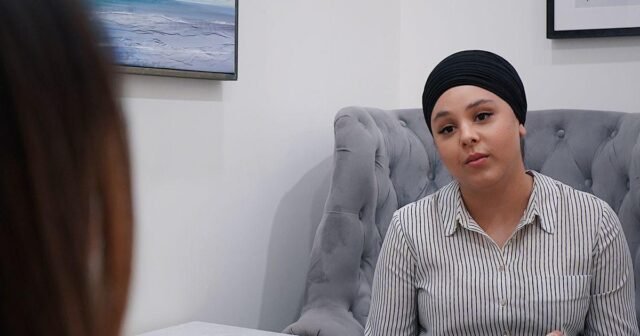
A supportive online therapy session — mostly conversation, from a space where you feel comfortable.
- Booking and confirmation. You choose a time and receive a secure video link by email or SMS. No app download is usually needed — most platforms open in a browser.
- Setting up. Find a private, quiet spot with a door that closes. Headphones help with confidentiality and sound quality. Test your camera a few minutes early.
- The intake conversation. Your therapist asks what brought you in, when the anxiety started, and how it affects daily life, sleep, and relationships. There are no wrong answers.
- Building a plan. Together you set goals and agree on an approach, often cognitive behavioural therapy. You will usually leave with one small step to try before the next session.
Sessions typically run 50 minutes. If technology drops out, most clinicians simply phone you to continue — a brief glitch will not end your appointment.
How Online Therapy Helps: The Skills You Learn
Online therapy helps by teaching practical, repeatable skills that reduce anxiety over time rather than only easing it in the moment. Cognitive behavioural therapy, the most studied approach, produced large improvements in anxiety through structured digital delivery in the 2016 Cochrane review (Olthuis et al., Cochrane, 2016). The gains come from what you learn to do differently.
CBT works on a simple loop: thoughts influence feelings, which influence behaviours, which feed back into thoughts. Anxiety often locks that loop into a cycle of worry and avoidance. Therapy helps you interrupt it.
- Cognitive restructuring — spotting and testing anxious predictions (“everyone will judge me”) against evidence.
- Graded exposure — approaching feared situations in small, planned steps so avoidance loosens its grip.
- Arousal regulation — breathing and grounding techniques that calm the physical symptoms of anxiety.
- Behavioural activation — rebuilding routines and activities that anxiety has narrowed.
Australian iCBT research shows these skills transfer online. In routine care, THIS WAY UP’s internet program for social anxiety produced large symptom improvements, with effect sizes around 0.82 to 1.09 (Mewton et al., Internet Interventions, 2015). Skills practised at home, in your own environment, are skills you keep.
Who Is Online Therapy Best Suited To?
Online therapy suits people who face barriers to in-person care — and that is a large group. Globally, only about 27.6% of people with anxiety disorders receive any treatment, meaning roughly three in four go without (WHO, Anxiety disorders fact sheet, 2025). Reducing the practical hurdles to starting therapy is exactly where online care earns its keep.
| Global anxiety treatment | Share of people affected |
| Receive treatment | 27.6% |
| Receive no treatment | 72.4% |
Most people with anxiety never get care. Source: WHO, 2025.
It is a particularly good fit if you live in a rural or regional area with few local psychologists, have a packed schedule, find leaving home during anxious periods difficult, or simply feel more comfortable opening up from your own space. Young adults are a key group too: 31.8% of Australians aged 16–24 had a 12-month anxiety disorder, the highest of any age band (ABS, 2020–2022).
| Group | Anxiety prevalence |
| Aged 16–24 (12-month) | 31.8% |
| All adults (lifetime) | 28.8% |
| All adults 16–85 (12-month) | 17.2% |
Anxiety is widespread, and heaviest among young adults. Source: ABS, National Study of Mental Health and Wellbeing, 2020–2022.
Online therapy is not right for everyone. In a crisis, or with severe symptoms, complex risk, or certain conditions, in-person or specialist care is required. A good clinician will tell you honestly if online is not the best fit for your situation.
How to Get Started With Online Therapy in Australia
Getting started is straightforward, and it can be affordable. Under Medicare, a GP can prepare a Mental Health Treatment Plan that gives you rebates for up to 10 individual psychology sessions each calendar year, delivered in person or by telehealth. Telehealth has become a standard, funded option rather than an exception (AIHW, 2021).
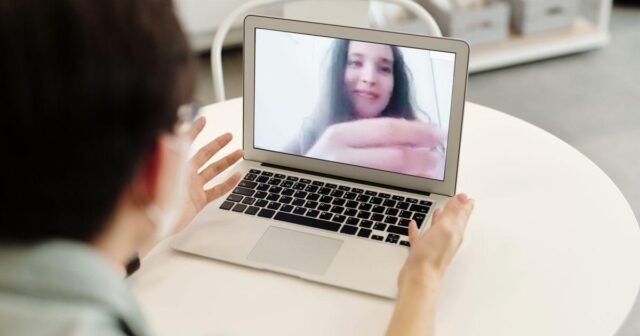
Telehealth is now a standard, Medicare-funded way to see a psychologist.
- Contact us. Send us a service request and explain what you need; we will do our best to support you.
- See your GP to discuss your symptoms and request a Mental Health Treatment Plan if appropriate.
- Choose a registered provider. All our psychologists are registered with AHPRA has experience with anxiety.
- Discuss the practicalities with your psychologist — session length, fees, rebates, and what happens if you need support between sessions.
You do not have to have everything figured out before you begin. The first appointment is where the plan gets made.
| Ready to talk to someone? If anxiety is getting in the way of your life, online therapy is a proven, accessible place to start. Limbic Flow offers secure telehealth sessions with registered clinicians experienced in treating anxiety. https://www.limbicflow.com.au/get-started/ |
| If you need help now This article is general information, not personal medical advice. If you are in crisis or worried about your safety, call Lifeline on 13 11 14 or 000 in an emergency. |
Frequently Asked Questions
Is online therapy as effective as in-person therapy for anxiety?
For most people with anxiety, yes. A 2021 meta-analysis of 664 participants found internet and face-to-face CBT statistically equivalent, with an effect size of 0.01 (Esfandiari et al., 2021). A 2016 Cochrane review reached the same conclusion.
How much does online therapy cost in Australia?
With a GP Mental Health Treatment Plan, Medicare provides rebates for up to 10 psychology sessions per calendar year, including telehealth. Out-of-pocket costs vary by provider. Do I need special equipment or tech skills for online therapy?
No. You need a device with a camera and microphone — a phone, tablet, or laptop — and a private, stable internet connection. Most video platforms open in a browser without an app. If your connection drops, clinicians typically continue the session by phone.
What if I feel too anxious to talk on camera?
That is common and completely valid. Many people find video easier than a clinic because they are in a familiar space. In 2021, video appointments made up 36% of Medicare mental health consultations (AIHW, 2021). You can also start with phone counselling or a guided iCBT program.
How long before online therapy helps my anxiety?
It varies, but structured programs often show change within weeks. Cognitive behavioural therapy delivered online produced large symptom reductions in the 2016 Cochrane review, typically over several sessions of practising new skills (Olthuis et al., 2016). Consistency matters more than speed.
The Bottom Line
Online therapy for anxiety is not a lesser substitute for the “real thing” — the evidence shows it is about as effective as in-person care, and for many Australians it is far easier to access.
- Anxiety affects 17.2% of Australian adults, yet only about 1 in 4 people worldwide get treatment.
- Three independent lines of research find online therapy roughly equivalent to face-to-face therapy for anxiety.
- Your first session is a supportive conversation, not a test — and Medicare rebates make it more affordable than many expect.
If worry, avoidance, or physical tension are shaping your days, a single conversation with a registered clinician is a reasonable next step.
About this article
Author: Limbic Flow Clinical Team.
Medically reviewed by: Sophia Tsai, B.S., MIPH, MA.
Last updated: 15 July 2026.
This article is general information only and does not replace personalised advice from a qualified health professional. It does not diagnose any condition or recommend a specific treatment for you. If your symptoms are severe or worsening, please consult your GP or a registered psychologist. In an emergency, call 000; for crisis support, call Lifeline on 13 11 14.
Sources
- Australian Bureau of Statistics — National Study of Mental Health and Wellbeing, 2020–2022. Retrieved 2026-07-15. https://www.abs.gov.au/statistics/health/mental-health/national-study-mental-health-and-wellbeing/latest-release
- World Health Organisation — Anxiety disorders (Fact sheet), updated 8 September 2025. Retrieved 2026-07-15. https://www.who.int/news-room/fact-sheets/detail/anxiety-disorders
- Olthuis JV, Watt MC, Bailey K, Hayden JA, Stewart SH — Therapist-supported Internet CBT for anxiety disorders in adults. Cochrane Database of Systematic Reviews, 2016 (CD011565.pub2). Retrieved 2026-07-15. https://www.cochranelibrary.com/cdsr/doi/10.1002/14651858.CD011565.pub2/full
- Esfandiari N, et al. — Internet-Delivered Versus Face-to-Face CBT for Anxiety Disorders: Systematic Review and Meta-Analysis. International Journal of Preventive Medicine, 2021. Retrieved 2026-07-15. https://pmc.ncbi.nlm.nih.gov/articles/PMC8724632/
- Watts S, et al. — A Multisite Non-Inferiority RCT of CBT for Generalised Anxiety Disorder Delivered by Videoconference. 2022. Retrieved 2026-07-15. https://pmc.ncbi.nlm.nih.gov/articles/PMC9572194/
- Titov N, et al. — User characteristics and outcomes from a national digital mental health service (MindSpot). The Lancet Digital Health, 2020. Retrieved 2026-07-15. https://pubmed.ncbi.nlm.nih.gov/33103097/
- Mewton L, et al. — The effectiveness of internet CBT for social anxiety disorder in routine care. Internet Interventions, 2015. Retrieved 2026-07-15. https://www.sciencedirect.com/science/article/pii/S2214782914000311
- Australian Institute of Health and Welfare — Mental health services in Australia: Medicare-subsidised services. Retrieved 2026-07-15. https://www.aihw.gov.au/mental-health/overview/mental-health-services